






Attacks on African migrants living in South Africa exploded during April, causing widespread destruction of lives and businesses. This article examines how political entrepreneurs exploit xenophobic rhetoric to gain political advantage, making migrant communities casualties of political manoeuvring.
Author bio: Clinton Nzala is a Nairobi-based political and social commentator.
On the 28th of April, just a day after South Africa’s Freedom Day, a day celebrated to mark the end of centuries of colonial and apartheid rule, vigilantes, a number of them in the traditional Zulu military gear took to the streets of the capital, Pretoria, marching to the Union Buildings, the country’s seat of power, demanding that African migrants be expelled from the country.
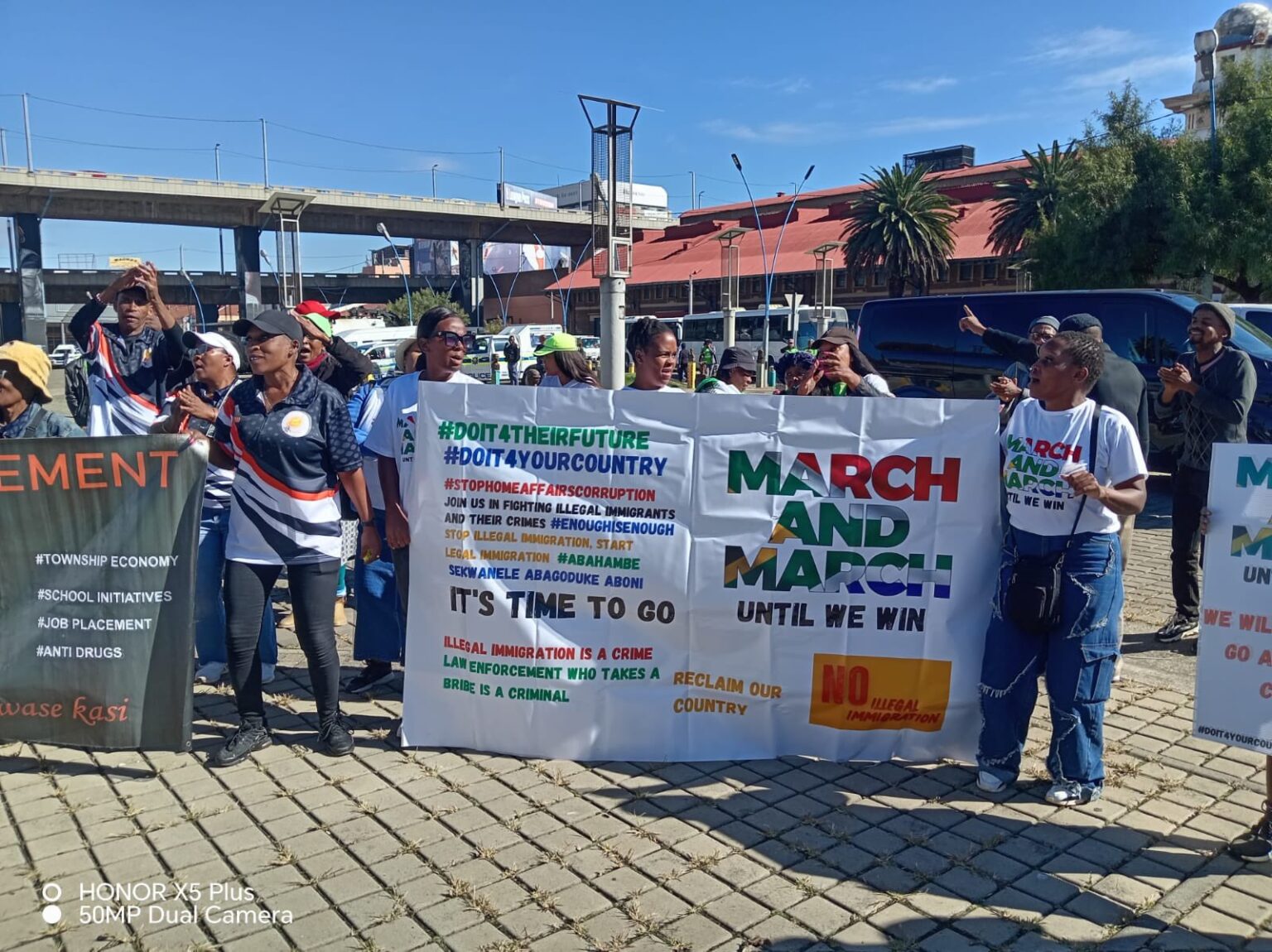
The march led by anti-migrant groups Operation Dudula and the March and March movement was a crescendo of weeks of violent attacks on African migrants and their businesses, whom they accuse of ‘stealing’ economic opportunities from South African citizens, a claim that is not supported by any solid facts.
In the last few weeks, videos of African migrants in South Africa being pummeled by vigilantes have circulated on social media, to the shock and disgust of many around the world.
While incidents of Xenophobia, or more aptly put, Afrophobia, due to the fact that the victims of the attacks have mostly been African migrants, have become a common occurrence in South Africa in the last two decades, the recent ones seem to be more organised and brazen, leading many to wonder about what could be behind the rise in this ‘Black-on-Black’ violence.
There is no single explanation for the surge in anti-migrant violence. However, a long-observed pattern shows that such attacks and rhetoric intensify during periods leading up to national elections in South Africa.
And in November 2026, the country will hold high-stakes local government elections to determine who will run its cities and municipalities.



WHEN IN DOUBT, BLAME THE AFRICAN MIGRANT!
Day by day, it has become clear that many political groupings, including Operation Dudula, which in August 2025 registered as a political party and expressed interest in running in this year’s elections, intend to use vitriol against African migrants to attract votes of the many South Africans who wrongly believe that the migrants are behind the country’s many social and economic woes.
Blaming migrants for everything, from high unemployment to not being able to find girlfriends, has become a favourite pastime for a large section of disgruntled South Africans.
A 2025 nationwide survey by the Inclusive Society Institute revealed that Afrophobic sentiment in South Africa is worsening. 73.1 per cent of respondents said they distrust African immigrants, up from 63 per cent in 2021.
Groups such as Dudula are hoping to use this rising anti-migrant violence to parachute themselves into the corridors of power in November.
To some, this might look far-fetched, but in South Africa’s political landscape, it is a tried-and-tested formula.
For years now, migrants have become political currency for politicians from both ruling and opposition parties. The ruling African National Congress (ANC) has on numerous occasions used migrants as scapegoats for its failure to adequately provide basic services to its citizens. For instance, in 2022, the then political head of the health department in South Africa’s Limpopo province, Phophi Ramathuba, accused Zimbabweans of ‘killing her health system.’
Image (Ramathuba) : https://x.com/PhophiRamathuba/status/1961798731566645535/photo/3
Image credit: X/PhophiRamathuba
A video of Ramathuba, a doctor-turned politician, chastising a Zimbabwean patient awaiting surgery at a hospital in Limpopo went viral. The ANC in the region later issued a statement stating that it ‘fully aligns with Ramathuba’s comments.’ Ramathuba would spend the next few months patrolling the region’s hospital, looking for undocumented migrants accessing health services. In 2024, Ramathuba was elected as the political head of Limpopo province, South Africa’s northernmost province, bordering Zimbabwe and Mozambique and serving as a key entry point for migrants into the country. While there are other reasons that could have contributed to Ramathuba’s victory, one thing was very clear: in South Africa, Afrophobia is an effective tool for climbing the political ladder, rather than an obstacle.
Ramathuba’s case of using Afrophobia to improve one’s political fortunes is not an isolated case.
One of the strongest electoral performances in South Africa’s 2024 general elections came from the Patriotic Alliance, led by Gayton McKenzie, an unapologetic Afrophobe who served nearly a decade in prison for armed bank robbery, yet today ironically presents himself as a voice against so-called African migrant criminality.
Image: Screenshot of this video https://x.com/GaytonMcK/status/1795765452074819739/video/1
Image credit: X/Gayton Mckenzie
McKenzie’s campaign slogan was ‘Abahambe,’ a Zulu word meaning ‘Let them (Africans) go.’ His campaign promises were even more extreme, including a pledge to disconnect African migrants from oxygen machines in hospitals if it meant saving local lives.
The ex-convict also carried out ‘citizens’ patrols on South Africa’s border with Zimbabwe, looking for undocumented African migrants.
Image : Screenshot of this article : https://iol.co.za/the-star/news/2024-01-04-pa-take-it-upon-themselves-to-monitor-sa-borders/
His Afrophobic antics did not go unnoticed by voters, in a period of five years, the PA’s share of the votes grew fifty-fold, moving from 0.04 percent in the 2019 general election to 2 percent in the 2024 polls, a figure high enough to earn the party nine parliamentary seats and a cabinet post in the so-called Government of National Unity, that was formed after none of the parties failed to garner the 50 percent plus one need for form government.
In the last few months, the PA has continued to grow by leaps and bounds, capturing local government seats from both the ANC and the main opposition, the Democratic Alliance (DA), in by-elections. In October 2025, the PA made history when it won a by-election in Soweto’s ward 29, marking the ANC’s first political defeat since 1994 in an area that for decades has been the liberation movement-turned-political party’s fortress.
The PA is unlikely to ever win a national election anytime soon, however what its success, however marginal it is, shows, is that Afrophobia is no longer a fringe sentiments but has slowly turned into a mainstream ideology that can provide a path to the gravy train, a train that the leaders of Dudula, and March and March are determined to get on, even if it requires stepping on the dead bodies of African migrants.
WHAT APARTHEID?
The need to get political power at any cost is the reason that we will continue to see the rise of Afrophobic outfits in South Africa. The leaders of these groups are definitely aware that African migrants working minimum wage jobs are not the cause of the economic exclusion of Black South Africans, but will keep singing this tune because it is easier than taking on the White Capitalists who still control the country’s economic pillars, three decades after the end of apartheid.
This is what makes this rise in Afrophobia more tragic; it is not only an attack on Pan-Africanism, but it also resulted in a situation where a significant amount of Black South Africans believe that their fellow Africans are the cause of their economic misery, and not the centuries of racial oppression which pushed them to the fringes of the country’s economy.